Sleep, Inc. Part II

I'm not sure exactly when I had my second encounter with sleep apnea, but if I could give a time frame it was after I was laid off from a company in 2010 at the same time my partner of ten years broke up with me. I was left unhoused, as we now say, and spent a lot of nights with men in exchange for a meal and a decent place to sleep. I was receiving unemployment so I could occasionally stay at a hotel for a week or two. I actually paid for an entire month at the Imperial Palace in Biloxi by playing blackjack. I also had a car. My goal was to drive around the country, find the spots I wanted to live and look for work in those locations. But this was in the wake of the 2008 recession and no one was hiring.
I had gone back to school at the now-defunct Art Institute of Fort Lauderdale. I had always enjoyed Fort Lauderdale and had only left because my partner wanted to move away for many valid reasons. Now that I was unencumbered, I felt like I could go back there and look for work. I made an arrangement with a hotel owner in there to stay there for a month. It was a wonderful recuperative time for me and I felt like the annoying hotel mascot for a bit. If you don't know anything about Fort Lauderdale, you must know that during the 1990s to the present it is a place where older gay men retire. My time at that hotel provided me, uhm, ample time to spend with these older men. One of them, Richard, had a CPAP. He was a wonderful guy, but I found it impossible to sleep with him for an entire night. The machine was like a wall between us preventing spontaneous intimacy. And if he fell asleep without it, it was like being in bed with Jim instead of just in the same room.
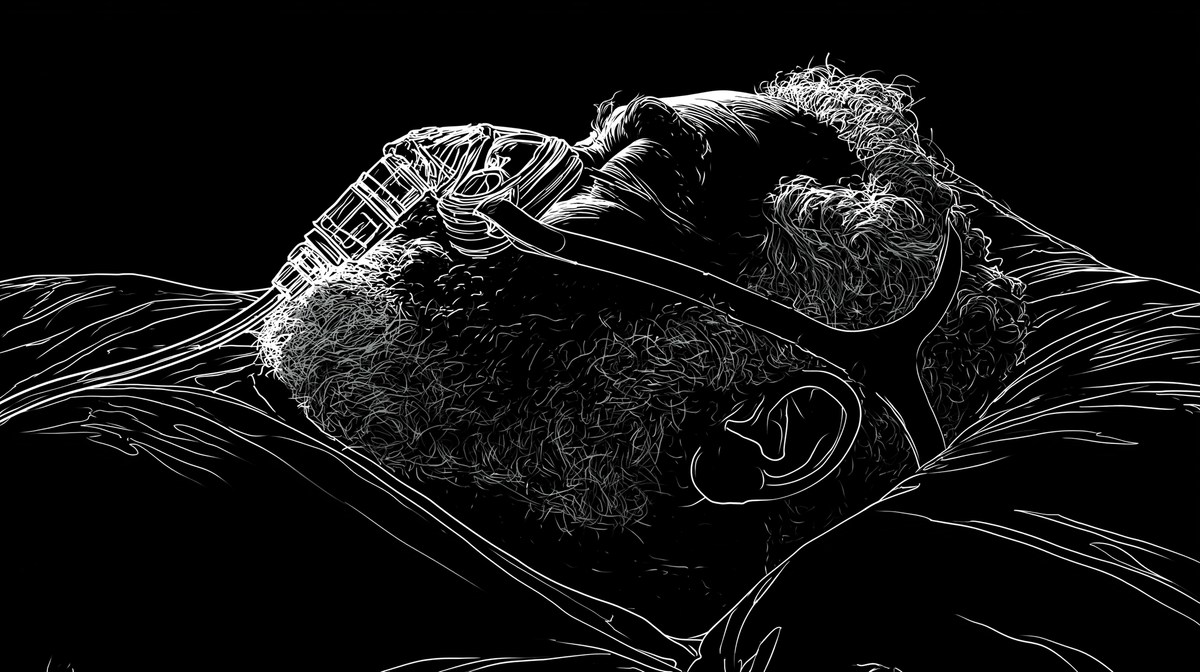
The way men that I have known talk about CPAPs, they do so in a way that almost seems like religious fervor to me. Once they started using the CPAP to force open their airways, their sleep improved exponentially. They bragged about having more energy and getting more out of life because of this clear plastic elephant trunk that they strapped to their face when they slept. I thought it was incredibly cool that they had found another means of helping people with sleep apnea without having an invasive surgery. But at that point I was not getting the full picture.
I lived this way for about 2 years until I moved back to Houston, my hometown, and coincidentally found a job that was horrible, but it was enough for me to spend the next year and a half swimming in a boozy funk. It was during this time, before I had been diagnosed with depression and PTSD, that I started seeing a doctor about painful stomach issues and trouble sleeping. I had been diagnosed with Generalized Anxiety Disorder in the mid-aughts. After receiving a clonazepam prescription, I was fine, but I was reluctant to take more than the dosage my doctors recommended. I had cycled off clonazepam while I was homeless and had just started taking it again. My new doctor prescribed Wellbutrin for what I now understand was depression manifesting as stomach problems, put me back on clonazepam, and then he did something I wasn't expecting. He recommended I go for a sleep study.
I don't object to new technology, and I believe that there are decent people out there working on the cutting edge of science, medicine, and technology, but in some ways, I am alarmingly old school. I can't stand the idea of contact lenses. Just the thought of caring for them and remembering to remove them and putting something on my eye bothers me to no end. And I'm someone who uses progressive lenses that have never worked properly to get my left eye to focus when I'm reading. Consequently, I carry old school pharmacy-bought reading glasses to use in a pinch. At the time, I was working with a colleague who had terrible bowel problems and had to wear a colostomy bag. I don't begrudge him that at all, but I couldn't do it. I think part of it comes from the realization that I am just not intuitive enough to take care of myself in a way that wouldn't leave contacts fused to my eyes or cause a terrible infection from dialysis, a colostomy bag, or any other life-extending technology or procedure. I'd rather just skip to the "let me die already" part of healthcare.
So, when the doctor suggested the sleep study, I was already aware of what a CPAP was and how that first step, the sleep study, almost always led to a diagnosis that ended with a CPAP prescription. I had long conversations with my doctor before he finally admitted that, indeed, in his experience with his patients, the sleep study usually led to a sleep apnea diagnosis and eventually a CPAP, which I knew I wouldn't use. Not because it wouldn't help, but because I would eventually stop using it for a variety of reasons. And I wouldn't be alone. According to a 2025 study published in Frontiers in Sleep, up to 51% of patients decline to even try PAP therapy after being diagnosed. But even with those dropout numbers, the money involved is staggering, and it's remarkably difficult to get a clear picture of just how much, because the people providing the numbers are often the same people selling the machines. Websites with telling names like cpapnation.com and sleepeducation.org are the ones providing the data. These websites are maintained by professional sleep medicine organizations and companies that sell sleep study services and equipment.
What we do know is this: an estimated 936 million people worldwide have obstructive sleep apnea. In the United States alone, an estimated 39 million people have it, and the majority remain undiagnosed. That's a massive pool of potential customers who just haven't been sent for a sleep study yet. The sleep study market by itself, just the diagnostic side, was valued at $1.08 billion in 2025 and is projected to hit $5.52 billion by 2036. That doesn't include the CPAP device market, which is its own multi-billion-dollar industry. And neither of those numbers includes the constant churn of replacement parts, which is where the real money lives. Untreated sleep apnea is estimated to cost the US economy $150 billion a year in lost productivity and healthcare costs. That figure gets cited a lot, usually by the people who stand to profit from treating it. But even if you cut it in half, you're looking at an economic argument so large that it justifies an entire industry built around getting as many people as possible from diagnosis to device. Because using a CPAP isn't just strapping it on your face and then drifting off to peaceful slumber.
Every night, you fill the humidifier chamber with distilled water. Not tap water. Distilled. Tap water leaves mineral deposits that breed bacteria. You attach the chamber to the machine, connect the hose, and then choose your mask. There are nasal masks, nasal pillow masks that sit just inside your nostrils, and full face masks that cover your nose and mouth. Each comes with its own problems. Nasal masks don't work if you breathe through your mouth at night. Full face masks are bulky and prone to leaks. Once you've chosen, you strap the headgear on and adjust it until you get a seal tight enough to prevent air from escaping but not so tight that it digs into your skin and leaves marks on your face in the morning. Then you turn on the machine. Then you try to fall asleep while pressurized air is being forced into your airways and a machine hums on your nightstand. If you're lucky, you get used to it. If you're not, you spend weeks or months fighting with it before you either adapt or the machine ends up in a closet.
And then there's the maintenance. Every morning you're supposed to empty the humidifier chamber, rinse it out, hang the hose to dry, and wipe down the mask cushion. Every week you wash the mask, the headgear, the hose, and the humidifier chamber with mild soap. Every month you check and replace the disposable air filter. Every one to three months you replace the mask cushion. Every three months you replace the entire mask. Every three to six months you replace the hose. Every six months you replace the humidifier chamber. Every single one of these components costs money.
I've always wanted a saltwater aquarium, but I've never invested much in the thought because I know the complexity of maintaining one would lead to the death of many innocent fish and perhaps an octopus. This process of maintaining a CPAP for your health sounds more time consuming and complicated than maintaining a saltwater aquarium, and I actually like fish more than myself.
There are multiple fail points for me in this process, from maintaining the proper moisture level to upgrading the different components of the machine when they inevitably fail. Yes, I said inevitably, because like so many industries, CPAPs have built-in obsolescence. And that's where the problems end up in the consumer's lap, whether they have the money to afford it or not.
You can read Part I here.
Part III is available here.
Part IV is coming soon.